
Singer-songwriter Charlotte Lawrence recently announced her engagement to Grammy-winning producer Andrew Watt, and her engagement ring has quickly become one of the most searched celebrity rings of the moment.
Based on publicly shared images, Charlotte Lawrence’s engagement ring appears to feature a large oval-cut diamond framed by a halo of vivid green baguette-cut stones, with additional diamonds extending along the band. The result is bold, graphic, and unmistakably Art Deco–inspired—a look rooted in early 20th-century design, even if the ring itself is newly made.
For those searching “Charlotte Lawrence engagement ring,” this piece stands out for its strong geometry, saturated color contrast, and vintage-inspired proportions.

What We Know About Charlotte Lawrence’s Engagement Ring
From the engagement images shared publicly, several defining elements are visible:
An oval-cut diamond center stone
A green baguette halo, widely believed to be emerald based on color and cut
Diamond accents along the shoulders of the band
While the jeweler has not been publicly credited, the design language closely aligns with Art Deco engagement rings from the 1920s and 1930s, which favored architectural structure, contrast, and precision over soft ornamentation.

Why Charlotte Lawrence’s Ring Feels So Art Deco
Art Deco jewelry is defined by symmetry, geometry, and intentional contrast. Charlotte Lawrence’s engagement ring reflects these principles in several key ways.
A Graphic Baguette Halo
Baguette-cut stones arranged in a halo create crisp lines and a tailored frame around the center diamond—one of the clearest hallmarks of Art Deco design.
Bold Color Contrast
The pairing of white diamond with saturated green stones echoes classic Deco combinations such as diamond and emerald, diamond and sapphire, or diamond and onyx.
Architectural Structure
Rather than a soft pavé halo, the ring uses color as a structural element, emphasizing outline and proportion over surface sparkle.
Historic Art Deco Halo Rings: The Roots of This Look
Charlotte Lawrence’s ring may feel fresh, but its design has deep historical precedent. During the Art Deco period, jewelers frequently framed diamonds with onyx, sapphire, emerald, and other colored stones to create bold, graphic silhouettes.
Diamond and Onyx: The Original High-Contrast Halo
Art Deco onyx halo rings are a textbook example of how color was used to define shape. The stark black-and-white contrast created a strong outline visible from across a room—precisely the same visual function served by emerald halos today.
Sapphire Halos in Art Deco Design
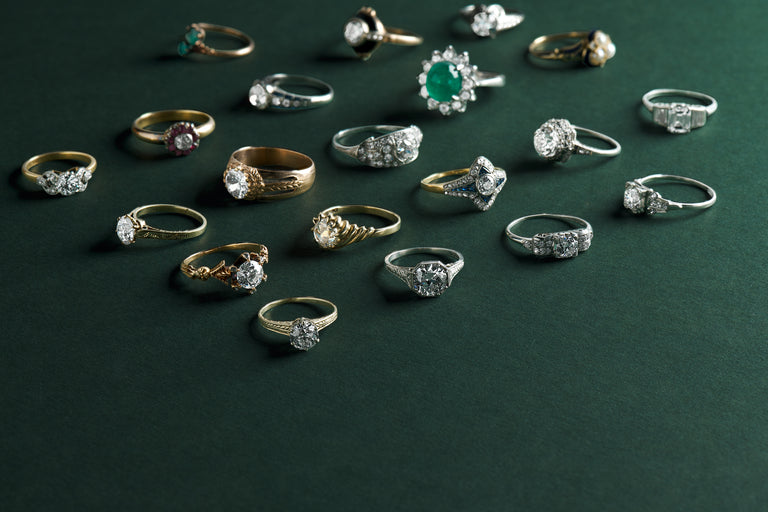
Rings such as this Art Deco old mine cushion diamond framed by sapphires demonstrate how jewelers used rich color to create symmetry and depth. Sapphire halos offered dramatic contrast while maintaining the era’s emphasis on clean geometry.
Target Rings: Color as Architecture
Target rings—diamonds encircled by a bold ring of color—are among the most iconic Art Deco styles. An Art Deco sapphire target ring or an emerald target ring with an Old European cut diamond shows how colored stones were used as deliberate architectural frames rather than decoration.
Charlotte Lawrence’s green halo ring follows this same lineage, using color to organize the design and focus attention on the center stone.
Emerald Halos: Quintessential Art Deco Design
Emerald was one of the most prized colored stones of the Art Deco era, favored for:
Its rich, unmistakable green
Its ability to create strong contrast with white diamonds
Its suitability for baguette and calibré cutting
An Art Deco marquise diamond framed by emeralds offers one of the closest historic parallels to Charlotte Lawrence’s engagement ring. While the center shape differs, the design philosophy is identical: elongated geometry, crisp lines, and saturated green used as a defining frame.
Beyond Halos: Other Bold Art Deco Engagement Ring Styles
Art Deco design was never one-note. While halo rings are iconic, the period produced a wide range of bold, distinctive engagement ring styles that share the same architectural DNA.
Elongated Center Stones
Marquise, oval, and elongated cushion diamonds were favored for their strong linear presence. An Art Deco marquise diamond engagement ring, even without a halo, achieves the same refined geometry seen in Charlotte Lawrence’s ring through shape alone.
Sculptural Platinum Designs
Some Deco rings rely on metalwork rather than color—featuring thick platinum mountings, stepped shoulders, and strong silhouettes that feel strikingly modern today.
Mixed-Cut Diamond Compositions
Art Deco jewelers often combined cuts within a single design. The contrast between old European, transitional, baguette, and specialty cuts added depth and visual rhythm.
Bullet-Cut Diamonds
Less common but unmistakably Deco, bullet-cut diamond rings highlight the era’s fascination with unusual stone shapes and bold profiles. These designs show how geometry itself can be the focal point.
How These Art Deco Examples Inform Custom Design Today
What unites all of these rings—emerald halos, sapphire targets, onyx frames, marquise centers, and bullet-cut diamonds—is a shared commitment to:
Intentional geometry
Strong contrast
Precision and proportion
Charlotte Lawrence’s engagement ring sits squarely within this tradition.
Creating a Ring Inspired by Charlotte Lawrence’s Engagement Ring
For those drawn to Charlotte Lawrence’s Art Deco–inspired ring, recreating this look successfully depends on more than color alone.
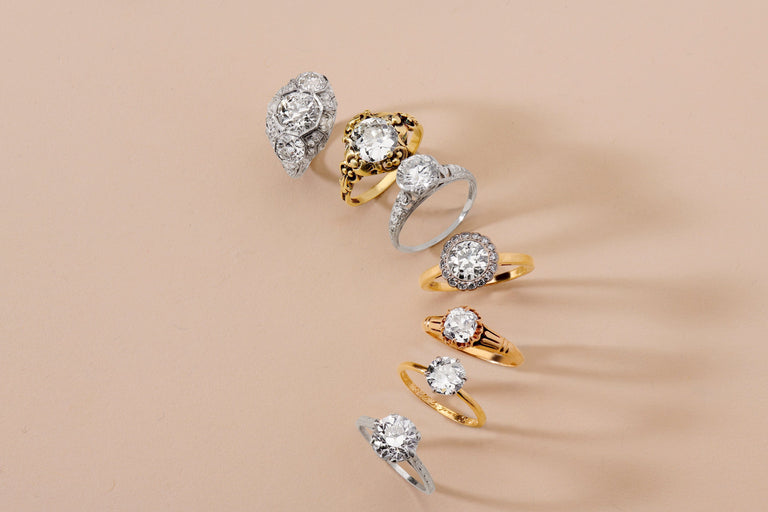
Antique Center Stones
We often begin with antique or early transitional diamonds, such as old mine cuts, old European cuts, or transitional cuts, chosen for their character and presence.
Calibré-Style Halo Construction
To achieve a true Deco aesthetic, green or colored stones must be carefully matched and proportioned to the center stone, creating a seamless, architectural frame.
Thoughtful Finishing
Details such as shoulder accents, band width, and profile height are refined to maintain balance and historical integrity while ensuring wearability.
The result is a one-of-a-kind engagement ring that captures the spirit of Art Deco design while being made specifically for the wearer.
Final Thoughts: A Modern Ring with Historic Roots
Charlotte Lawrence’s engagement ring feels contemporary, but its appeal lies in something timeless: bold geometry, strong contrast, and intentional design. By looking to historic Art Deco engagement rings—emerald halos, sapphire targets, onyx frames, elongated diamonds, and sculptural settings—we see that this style has been captivating for over a century. For those inspired by this ring, Art Deco offers endless possibilities: structured, expressive, and unmistakably enduring.